

Plastic injection moulding is a cyclic manufacturing process. Plastic granules are heated until molten, injected under pressure into a mould cavity, held under pressure while the part solidifies, and then ejected before the cycle repeats. Every one of these cycles depends on removing heat from the mould at a controlled, repeatable rate — the cooling stage, more than the injection stage, determines how quickly a part can be safely ejected and the next cycle started.
Cooling in injection moulding is almost always carried out using temperature-controlled water that circulates through channels drilled or cast into the mould. As the hot melt contacts the mould wall, heat passes from the plastic into the mould body and then into this circulating water. If the water is not held within a defined temperature band, the mould surface temperature drifts, and with it, the time each part needs to solidify enough for safe ejection.
Because injection moulding repeats the same cycle hundreds or thousands of times in a shift, small variations in cooling water temperature compound over time. An industrial chiller's role is to hold the supply water temperature steady, cycle after cycle, so that mould cooling — and with it, cycle time and part quality — stays consistent for as long as the machine runs.
Get a free quote today or download our catalogue to explore Gem Orion Industrial Chillers.
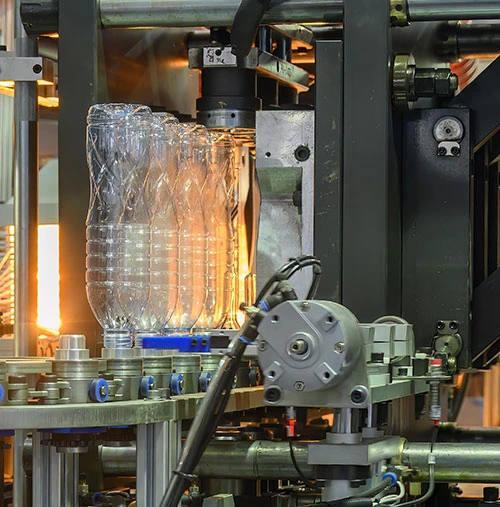
Considering a chiller for your injection moulding process? Our engineering team can help you size and specify the right CHT Series configuration.
Why Cooling Is Important in Plastic Injection Moulding
Heat enters the mould from two directions: the molten plastic itself, and, on hydraulic machines, the hydraulic oil that powers clamping and injection. Both need to be removed continuously for the process to run without interruption.
Mould cooling typically accounts for a large share of the total injection moulding cycle — often its single longest stage. How quickly and how evenly the mould gives up this heat has a direct bearing on:
- Cycle consistency — a mould running at a stable temperature produces a repeatable cooling time, cycle after cycle. A mould that runs hot, or drifts in temperature, changes the required cooling time unpredictably.
- Part dimensions — plastic shrinks as it cools. Uneven or inconsistent mould temperature can lead to uneven shrinkage, which shows up as dimensional variation between parts, or warping within a single part.
- Surface finish — where mould surface temperature runs too hot or too cold for the process, surface defects such as sink marks, flow lines, or inconsistent gloss can appear.
- Production stability — a stable cooling water supply lets the moulding machine's set parameters (injection pressure, hold time, cooling time) keep producing the same result shift after shift, without the operator compensating for a drifting mould temperature.
These outcomes depend on more than the chiller alone — mould design, gate location, material grade and machine settings all play a role. What the chiller controls is one input to the process: keeping the cooling water supplied to the mould at a stable, correct temperature.
How an Industrial Chiller Is Used in Injection Moulding
An industrial chiller works in a closed loop alongside the injection moulding machine:
- Chilled water leaves the chiller and is supplied to the mould's cooling channels, and, on hydraulic machines, to the oil cooler.
- As this water circulates through the mould, it absorbs heat from the hot plastic and the mould body.
- The now-warmer water returns to the chiller as "return water," at a higher temperature than it left.
- The chiller's refrigeration circuit removes this heat from the return water.
- The cooled water is recirculated back to the mould, and the cycle continues for as long as the machine is running.
The chiller does not contact the plastic directly — it conditions only the water that does. Its task is to remove heat from the return water fast enough, and consistently enough, that the supply water temperature does not drift as production continues through a shift.
Cooling Requirements in Plastic Injection Moulding
Several parameters together determine what a moulding process actually needs from a chiller. Each affects the outcome differently:
← Swipe sideways to view →
| Parameter | Why It Matters |
|---|---|
| Process heat load | Sets the cooling capacity (TR) required — driven by shot size, cycle rate and the material being processed. |
| Required water / set-point temperature | Different resins and part geometries call for different mould temperatures; the chiller should be set to match the process, not simply run as cold as possible. |
| Water flow rate | Insufficient flow through the mould channels limits heat removal even when the chiller has adequate capacity. |
| Inlet / outlet temperature difference | A wider gap between supply and return water indicates more heat is being picked up per pass — useful for checking whether cooling is doing its job. |
| Machine and process conditions | Shot size, cycle time and cavity count all change how much heat the process generates over a given period. |
| Production cycle / duty | A chiller sized for occasional short runs will be under-specified for continuous, multi-shift production. |
| Ambient temperature | Air-cooled chillers reject heat to the surrounding air; higher ambient temperatures reduce a chiller's effective cooling capacity. |
These parameters are interdependent. Flow rate without adequate capacity, or capacity without adequate flow, both lead to unstable mould temperatures. Correct chiller selection accounts for all of them together, not capacity in isolation.
How to Select the Right Industrial Chiller Capacity
Chiller capacity should be selected based on the actual heat load of the moulding process — not on machine tonnage or shot size alone. Two machines of similar size can carry very different cooling loads depending on the material being processed, cycle speed, and the number of cavities running.
Gem Orion's CHT Series Industrial Chiller is available across a wide capacity range, from 1 TR to 50 TR, which allows the chiller to be matched to a single small machine or scaled up for a larger, multi-cavity, or multi-machine cooling load.
We do not recommend a specific TR rating for a particular machine without reviewing the actual process. The correct capacity depends on machine tonnage, shot weight, material, cycle time, the number of machines to be served, and ambient conditions at the plant. Customers evaluating a chiller for an injection moulding application are encouraged to share these process details with Gem Orion's engineering team, so that capacity is selected on that basis rather than estimated in isolation.
Gem Orion CHT Series Industrial Chiller
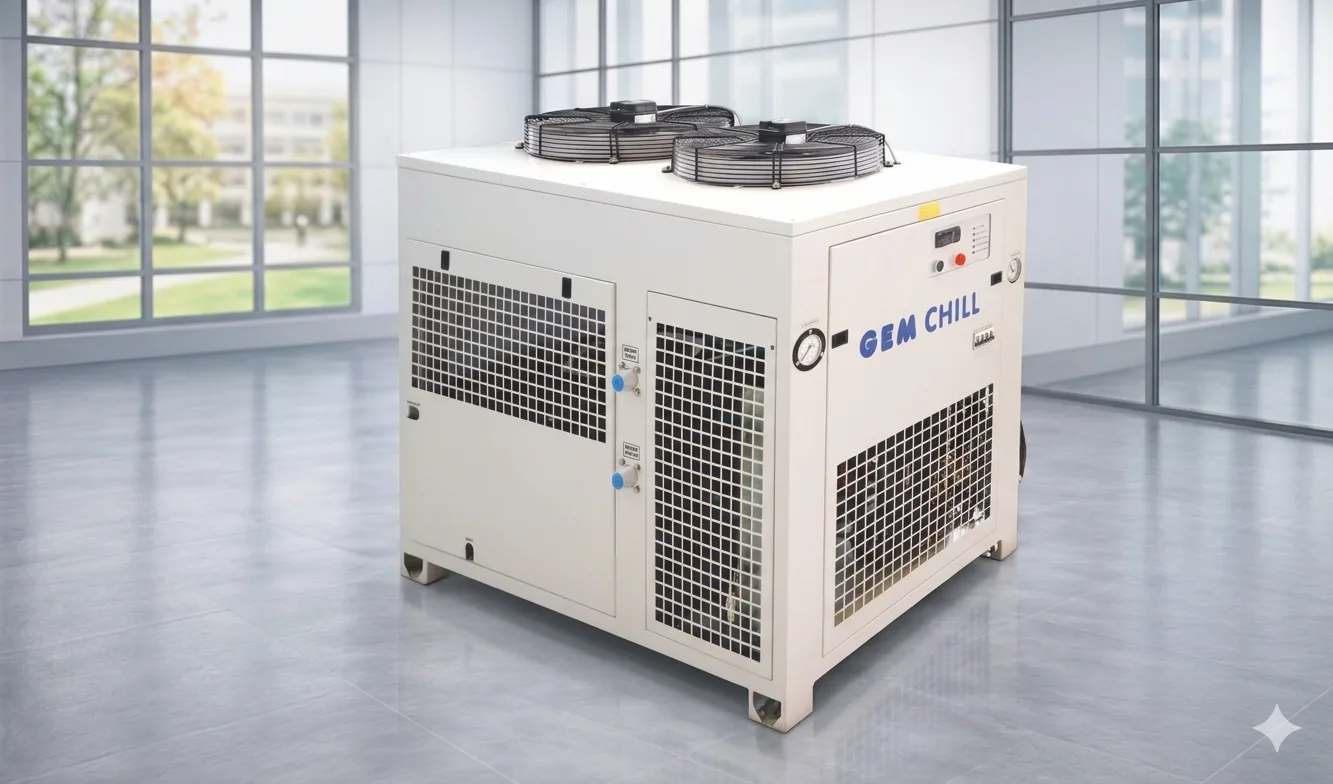
The CHT Series Industrial Chiller is Gem Orion's cyclic industrial chiller range, built for general industrial process cooling, including plastic processing. Eleven standard air-cooled models cover the 1 TR to 50 TR range, each fitted with a built-in closed tank, an in-built high-pressure pump, and microprocessor-based controls as standard.
Full model-wise details — including dimensions, weight and per-model cooling capacity across the CHT range — are available on the CHT Series product page (linked above).
← Swipe sideways to view →
| Specification | Value |
|---|---|
| Capacity range | 1 TR to 50 TR |
| Operating range | 10°C to 25°C |
| Temperature control | ±2.5°C from set point |
| Ambient operating range | 10°C to 45°C |
| Refrigerant | R407C |
| Tank | Built-in closed tank |
| Pump | In-built high-pressure pump (SS304 impeller and SS body) |
| Controls | Microprocessor-based controls |
| Condenser configuration | Air-cooled (standard); water-cooled condenser available as an option |
Suitable Plastic Injection Moulding Applications
Within plastic injection moulding, the CHT Series is suited to:
- Cooling water supply for injection moulding machine mould cooling channels.
- Cooling support for plastic component manufacturing where mould temperature control affects part quality — see industrial chiller applications across other sectors.
- Repeated, cyclic production processes where the moulding machine runs continuous shift-length production.
- General-purpose process cooling for injection moulding facilities running one or more machines from a central or dedicated chiller.
The CHT Series operates on a fixed-speed (non-inverter) refrigeration circuit, which suits applications where the cooling load is broadly steady through the shift. For processes with a widely fluctuating heat load, or where variable-speed response and tighter-than-±2.5°C control is a specific requirement, Gem Orion's inverter-driven chiller range may be more appropriate. Which configuration fits best should be confirmed against the actual process, not assumed from machine type alone.
Benefits of Proper Process Cooling
Correctly specified and maintained process cooling supports the moulding process in practical, process-level ways:
- Stable process temperature at the mould, cycle after cycle.
- Consistent mould cooling, supporting repeatable part dimensions and surface finish.
- Better process control, with less need to compensate for a drifting cooling water supply.
- Repeatable production conditions across a shift and between shifts.
- Reduced risk of temperature-related process variation as production volume and run length increase.
These are outcomes of stable, correctly sized cooling working alongside sound mould design and process settings — not a substitute for either.
Recommended Gem Orion Solution
For plastic injection moulding cooling loads that run on a broadly steady, cyclic basis — the typical pattern for shift-length production runs — the CHT Series Industrial Chiller is Gem Orion's recommended starting point. Its 1 TR to 50 TR range, built-in tank, high-pressure pump and microprocessor controls make it a straightforward fit for supplying stable, temperature-controlled water to a mould's cooling channels.
This recommendation applies to cyclic cooling loads specifically. It is not presented as the right fit for every injection moulding application without qualification — processes with a widely fluctuating heat load, or a requirement for tighter temperature control than ±2.5°C, should be discussed with Gem Orion's engineering team, who can confirm whether the CHT Series or an inverter-driven alternative is the better match.
Common Injection Moulding Problems and Cooling Solutions
Injection moulding manufacturers may experience inconsistent cooling conditions, mould temperature variation, changing cycle times, dimensional variation and surface-finish issues. These problems can have multiple causes, but stable cooling-water temperature is an important process factor to control.
← Swipe sideways to view →
| Injection Moulding Problem | How Proper Cooling Helps |
|---|---|
| Mould temperature fluctuates | Maintains controlled cooling-water temperature for more consistent mould cooling. |
| Cooling water becomes hot during production | Removes heat from the return water and recirculates cooled water to the mould. |
| Cooling conditions are inconsistent | Provides continuous recirculation of temperature-controlled water during production. |
| Cycle conditions vary | Stable cooling conditions support a more repeatable cooling stage. |
| Parts show dimensional variation | Consistent mould cooling supports more uniform cooling and shrinkage conditions. |
| Surface finish varies | Helps maintain the mould temperature required by the process. |
| Cooling flow is insufficient | The CHT Series includes an in-built high-pressure pump for process-water circulation. |
| Multiple machines require cooling | The 1 TR to 50 TR CHT range allows capacity to be matched to the combined process load. |
Related Blog
Injection moulding is one of several plastic manufacturing processes — extrusion, blow moulding and thermoforming all depend on process cooling in a similar way. Why Every Plastic Manufacturing Unit Needs a Chiller looks at why chillers are essential across plastic manufacturing more broadly, beyond injection moulding on its own, and is a natural next read for visitors to this page.

