
Drag

Contact info

Email
sales@gemorion.in
Location
Arasur, Tamilnadu

Follow us

Trusted partner in industrial excellence Join us now

Chiller for Induction Heating Machines

Gem Orion industrial chiller for induction heating machines
Chat on WhatsApp

Chiller for Induction Heating Machines: Sizing, Water Quality and Model Selection

Quick answer: Size the chiller from the machine maker's cooling-water spec: Heat load (kW) = Flow (L/min) × Temperature rise (°C) ÷ 14.3. Use a closed-loop chiller with DM or softened water, keep supply water at a non-condensing 25 °C and above, choose the GKE inverter series for stop-start hardening and brazing, and the GKL heavy-duty series for continuous forging and melting.

Author Profile
Authored by

Ramesh Kumar A B

Date Released

12 Oct, 2026

An induction heater puts energy into the workpiece, but a large part of the electrical input ends up as heat inside the machine. The copper coil carries very high current and heats up within seconds, while the power supply's IGBTs, capacitors and transformer run hot too. Without proper cooling, the machine trips on over-temperature, the coil overheats and capacitors age fast.

A closed-loop industrial chiller keeps cooling water clean and at a steady temperature, so induction hardening, brazing and forging lines run every shift without stopping.

Where the heat comes from

  • ✅ Induction coil: hollow copper tube with water inside. It carries the highest heat load and is most sensitive to scale.
  • ✅ Power supply: IGBT modules, rectifiers and heat sinks need clean water at a controlled inlet temperature.
  • ✅ Capacitor bank and output transformer: water-cooled on most medium- and high-power machines.
  • ✅ Quench system: usually a separate tank and circuit. Keep it apart from the coil circuit.
Common induction heating applications

  • ✅ Induction hardening of shafts, gears, crankshafts, camshafts and axle parts
  • ✅ Brazing of copper joints, carbide tool tips and HVAC components
  • ✅ Forging and billet heating before hot forming
  • ✅ Annealing, tempering and stress relieving of tubes, wires and welded parts
  • ✅ Induction melting furnaces for steel, cast iron, copper and aluminium

Hardening and brazing heat in short bursts, while forging and melting run near full load for hours. That decides whether an inverter or heavy-duty chiller gives the best value.

Gem Orion GKE inverter chiller for induction hardening

Signs your present cooling is not enough

  • ✅ Over-temperature trips during hot afternoons, especially in April and May
  • ✅ Scale or rust in the inlet strainer and a gradual drop in cooling water flow
  • ✅ Discoloured, pitted or leaking induction coils that need frequent replacement
  • ✅ Capacitor bank or power cabinet running hot to the touch

If you see two or more of these, your cooling system is limiting output.

Chiller vs cooling tower

Many shops still cool induction machines with an open cooling tower. It works on a mild day but has two problems:

  • 1. Temperature follows the weather. In April–May, tower water can reach the low-to-mid 30s °C, close to or above the maximum inlet temperature many machine makers allow. The machine derates or trips.
  • 2. Open water scales the coil. Dust and dissolved salts build scale inside the hollow copper coil. Flow drops, the coil runs hotter and eventually fails.

A closed-loop chiller solves both: the water temperature is set, not left to the weather, and the sealed loop keeps DM or softened water clean for months.

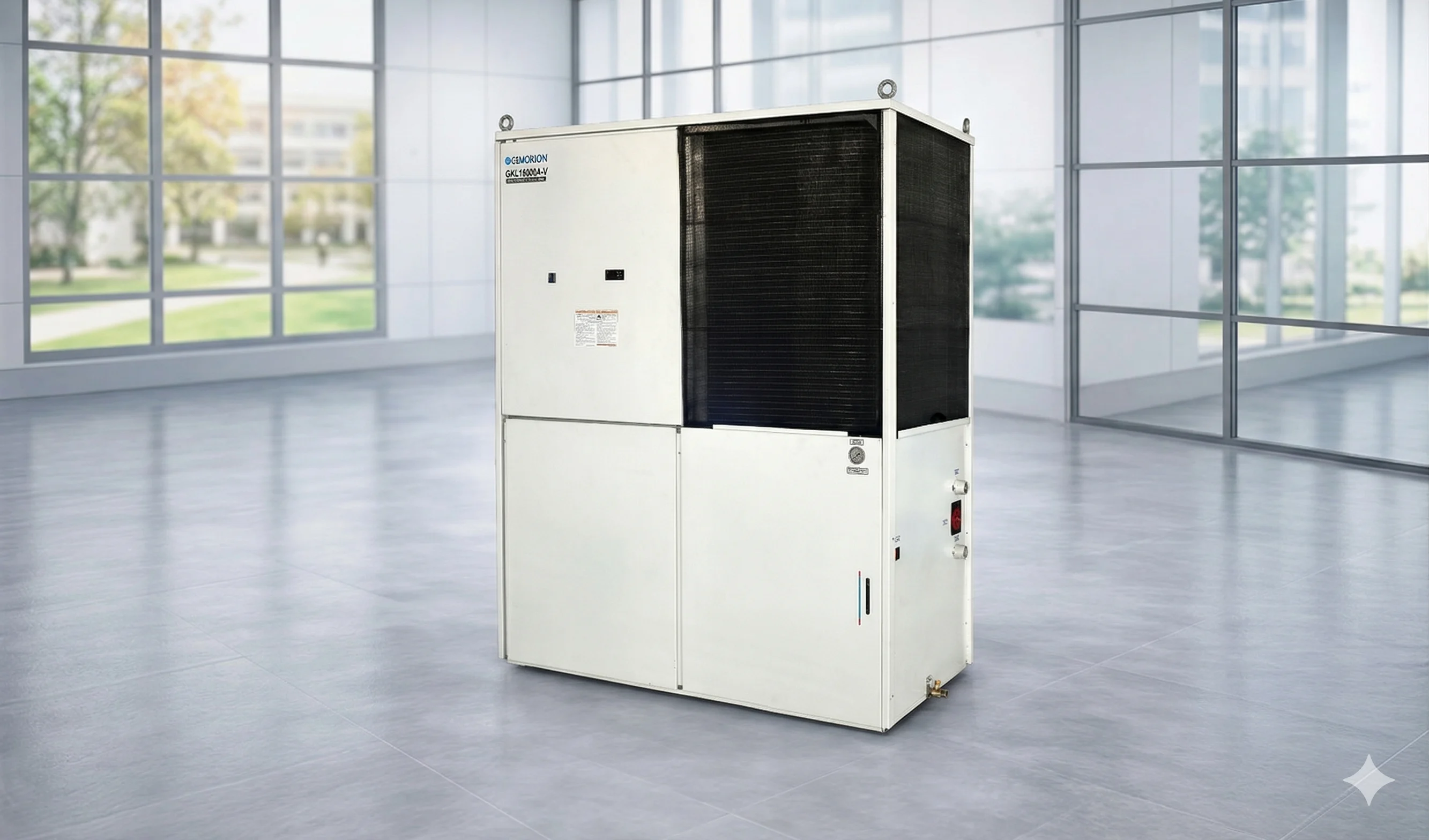
Gem Orion GKL heavy-duty precision chiller for induction machines

How to size the chiller

Start with the machine maker's cooling-water specification: required flow, maximum inlet temperature and allowed temperature rise. Then calculate:

Heat load (kW) = Flow (L/min) × Temperature rise (°C) ÷ 14.3

Example: an induction hardening machine needs 40 L/min with an 8 °C rise. Heat load = 40 × 8 ÷ 14.3 = 22.4 kW. The Gem Orion GKE 7500A-V inverter chiller (25 kW) is a suitable starting point. If the shop floor runs above 38 °C in summer, step up to the GKE 11000A-V (35 kW).

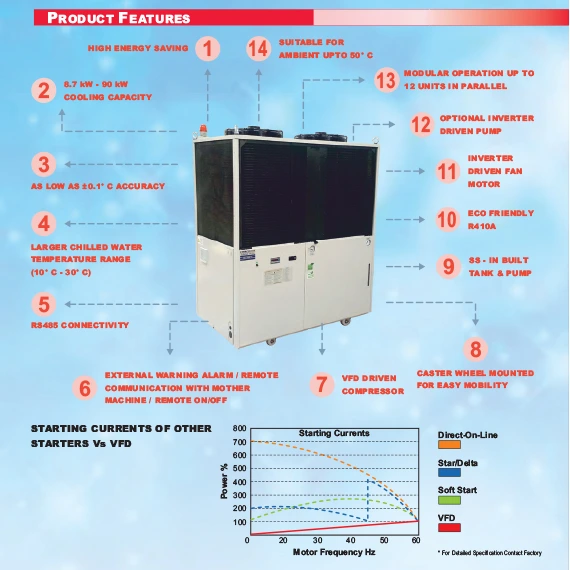
Check pump pressure too: narrow coil passages need pressure as well as flow. GKE and GKL chillers have built-in SS pumps rated up to 6 bar / 60 m head.

Water quality and set temperature

  • ✅ Use DM or softened water, never raw borewell water. Gem Orion chillers are designed for DM water, pure water and water–glycol.
  • ✅ Keep the loop closed. The SS304 tank and SS316 plate heat exchanger keep rust out of the circuit.
  • ✅ Check conductivity and water level regularly, and clean the inlet strainer at every service.
  • ✅ Don't run the water too cold. Below the dew point, moisture condenses on the coil and inside the power cabinet. Most machines run well at 20–28 °C supply water; however, a non-condensing temperature of 25 °C and above is better.

Which Gem Orion chiller to choose

← Swipe sideways to compare →

SituationRecommended seriesWhy
Hardening or brazing with stop-start heating cyclesInverter Chiller – GKECompressor speed follows the swinging load; up to 30–40% energy saving
Continuous high-load heating, forging, meltingHeavy-Duty Precision – GKL (or) Inverter Chiller – GKE12–96 kW, ±1 °C, built for 24/7 duty
Coil and power supply need separate water temperaturesGKL / GKE models with a thermal valveThermal valve regulates the water flow and thereby maintains the quench water tank temperature

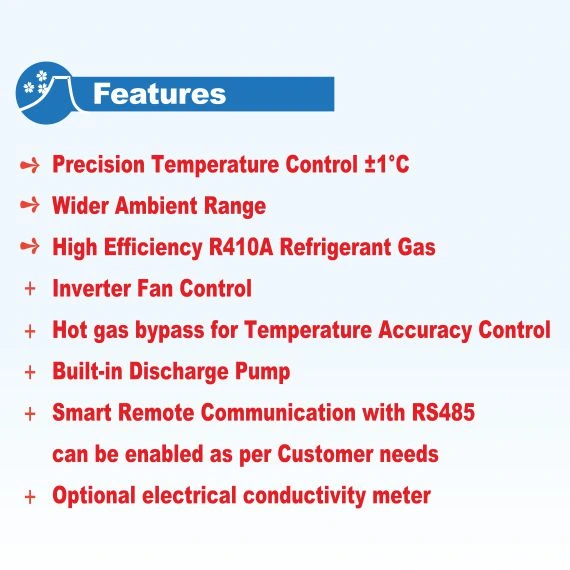
All units use R-410A refrigerant and carry remote on/off and potential-free fault contacts as standard, so the chiller can be interlocked with the induction machine.

Installation and maintenance tips

  • ✅ Place the chiller close to the induction machine and keep pipe runs short to reduce pressure loss.
  • ✅ Leave at least one metre of free space around the condenser so hot air does not recirculate.
  • ✅ Wire the chiller's fault contact to the machine interlock so heating stops if cooling fails.
  • ✅ Clean the condenser dust filter every month, more often in dusty forging shops.
  • ✅ Record water level, conductivity and pump pressure at every service.
Gem Orion industrial chiller installation for induction heating

Frequently asked questions

What temperature should cooling water be for an induction heater?
Follow the machine maker's range. Most machines run well at 20–28 °C, kept above the shop-floor dew point.

Can one chiller cool both the coil and the quench tank?
Yes, it is possible with an additional heat exchanger. The chiller works on a closed-loop system for the coil line. With the additional heat exchanger, chilled water runs in a closed loop through the heat exchanger, while the quench tank water forms a separate loop between the tank and the heat exchanger with its own circulation pump. The two waters must not be mixed, as the quench water carries oil, polymer and scale, so keep it on a separate circuit.

Why choose an inverter chiller for induction hardening?
Hardening machines heat in short cycles, so the cooling load swings all the time. An inverter chiller matches compressor speed to the load instead of switching on and off, which saves power and keeps water temperature steady.

Get the right chiller for your induction machine

Share your machine's power rating, flow and maximum inlet temperature for a model recommendation and quote. Gem Orion Machinery will size the chiller for your line.

logo
logo

Stay Updated with Us

Call Us