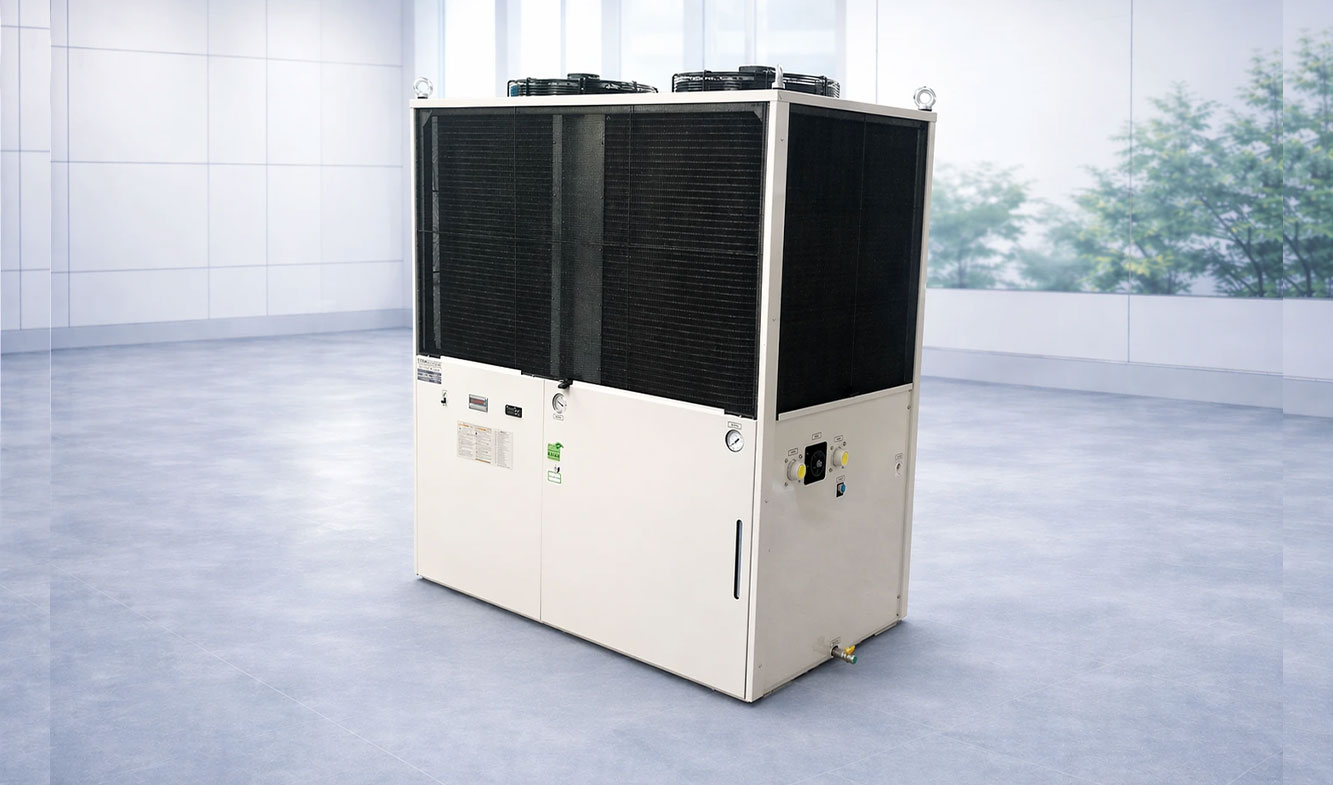
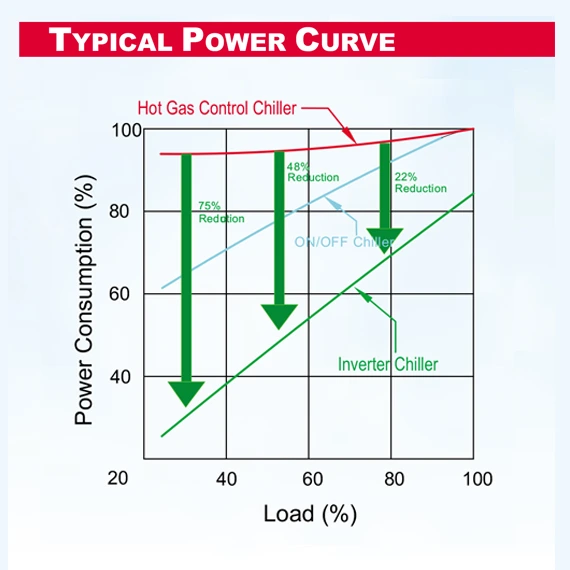
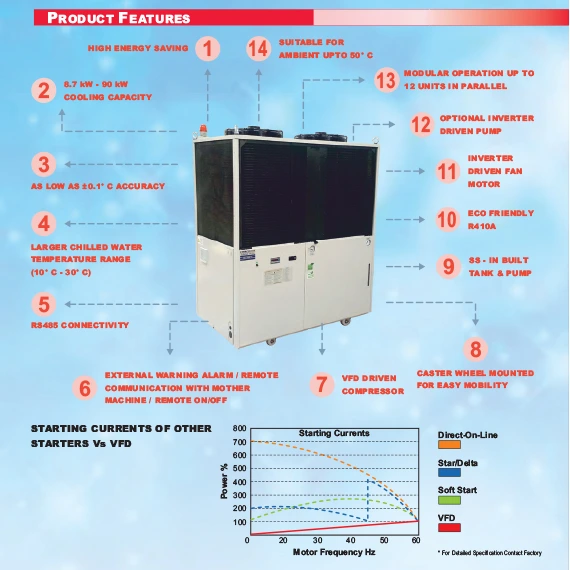
- ✅ Variable-speed scroll compressors ramp up or down smoothly with IT load, instead of cycling on and off, cutting mechanical wear and energy waste
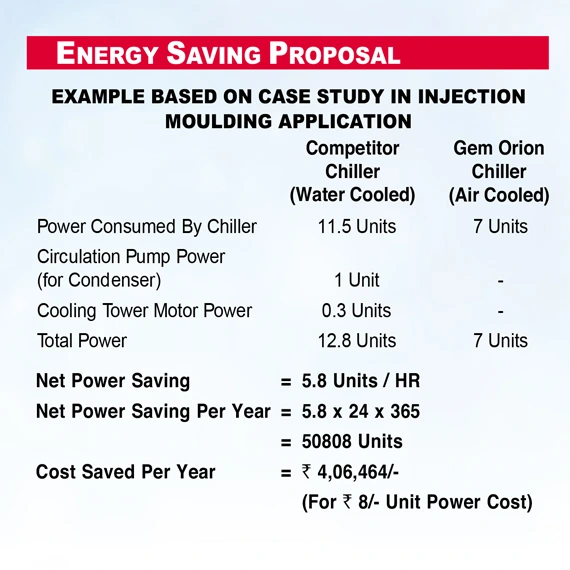
- ✅ Rated energy savings of up to 30-40% compared to conventional fixed-speed chillers — a direct, measurable improvement to PUE
- ✅ Temperature control accuracy of ±0.1°C under stable load conditions (±0.5°C as standard spec), keeping server room conditions inside a tight, predictable band
- ✅ Modular design — up to 12 units can be connected together, making N+1 redundancy straightforward to build in so a single unit failure never means a hot aisle
- ✅ SS316 brazed plate heat exchangers and a SS304 water tank for long service life in continuous, 24/7 operation
- ✅ Environment-friendly R410A refrigerant, with remote on/off and RS485 connectivity for integration into existing building management or monitoring systems
- ✅ Available across ten models from 8.7 kW to 110 kW, so the system can be sized to the room instead of forcing the room to fit an oversized or undersized unit
For a facility where every degree and every kilowatt is being measured, a chiller that adjusts itself to the load — rather than one that alternates between overshooting and undershooting it — changes the economics of running the room.
Looking past the purchase price: total cost of ownership
A chiller's sticker price is only the first number that matters — the second, larger number is what it costs to run every month for the next ten years. Cooling is one of the biggest recurring line items in a data center's power bill, so a unit that's 10% cheaper to buy but 30% less efficient to run is rarely the cheaper choice once it's been operating for a year. With rated energy savings of 30-40% over fixed-speed alternatives, the GKE Series is generally evaluated on total cost of ownership — purchase price plus the power bill over the equipment's working life — rather than on upfront cost alone, and that's the comparison worth running before deciding what to install.
Common questions data center teams ask
Does switching to inverter chillers mean redesigning the whole cooling plant?
Not necessarily — units can typically be added alongside existing plant, and RS485 connectivity lets new units report into whatever monitoring system is already in place.
What ambient conditions can the GKE Series handle?
It's rated from 5°C to 50°C ambient, which covers most of India's climate zones without needing a specially controlled plant room.
How does capacity scale as the facility grows?
Ten models span 8.7 kW to 110 kW, and up to 12 units can be networked together — so growth is handled by adding units, not replacing the system.
Is the refrigerant environmentally compliant?
Yes — R410A is used across the range, in place of older, more damaging refrigerants.
Air-cooled or water-cooled — which is better for a data center?
Air-cooled units like the GKE Series avoid the water treatment and cooling-tower upkeep that water-cooled systems need, which is usually simpler to operate for a server room, though very large facilities sometimes mix both depending on available space and water access.
How is chiller capacity (TR or kW) calculated for a server room?
It starts from the total IT and support-equipment heat load in kW, converted to tonnes of refrigeration (1 TR is approximately 3.5 kW), then sized up with a safety margin for the redundancy configuration chosen. Gem Orion's engineering team can run this calculation from your rack layout and power draw.
What does a data center chiller cost in India?
Cost depends on capacity, the number of units needed for redundancy, and site-specific installation work — Gem Orion quotes this per project based on the load and configuration, since a single published number would be misleading across such different facility sizes.