


Drag

Contact info

Email
sales@gemorion.in
Location
Arasur, Tamilnadu

Follow us

Trusted partner in industrial excellence Join us now

GCC Series Coolant Chiller for CNC Precision Machining !

Gem Orion GCC Series coolant chiller for CNC machine tool precision cooling
Download Catalog
Chat on WhatsApp

GCC Series Coolant Chiller

Quick answer: India's CNC and precision machining sector is growing 8-10% a year on automotive, aerospace, and EV demand. The real limit on tolerance today usually isn't the machine — it's thermal drift from an uncontrolled coolant loop. Gem Orion's GCC Series holds coolant at a stable set temperature so every part sees the same thermal conditions, from part 1 to part 1,000.

Author Profile
Authored by

Ramesh Kumar A B

Date Released

13 Aug, 2026

Comments
00 Comments

Precision machining in India is entering a different league

India's machine tool and precision engineering market is growing at 8–10% CAGR, pulled forward by automotive component makers, aerospace and defence manufacturing expansion, and a fast-diversifying supply base moving into EVs, semiconductors, and data centre hardware under the PLI push. CNC shops that used to hold ±0.05mm tolerances comfortably are now being asked for tighter specs, faster turnaround, and longer unattended run times.

The machine itself usually isn't the bottleneck anymore — modern CNC spindles and axes are accurate enough. What breaks tolerance in practice is thermal drift: the coolant, the workpiece, and the machine structure all expanding and contracting as temperatures shift through a shift or a production run. And that's a coolant temperature control problem, not a machine problem.

Why coolant temperature is the hidden tolerance killer

Cutting coolant does two jobs — it removes heat from the cutting zone, and it flushes chips away. When coolant temperature isn't held steady, both jobs degrade at once:

  • ✅ As coolant warms up over a run, it removes less heat per pass, so the workpiece and tool run progressively hotter — parts machined at hour six can measure differently from parts machined at hour one
  • ✅ Thermal expansion of the workpiece and machine bed shifts the actual cutting position relative to the programmed one, showing up as dimensional drift that's hard to trace back to a single cause
  • ✅ Warmer coolant is thinner and less effective at chip evacuation, increasing tool wear and surface finish inconsistency
  • ✅ On multi-shift or 24/7 lines, an uncontrolled coolant loop means the first part of a shift and the last part are effectively machined under different thermal conditions

For shops chasing tighter tolerances on automotive, aerospace, or EV components, this is exactly the kind of variability that fails inspection intermittently and is maddening to diagnose — because nothing about the machine's settings changed.
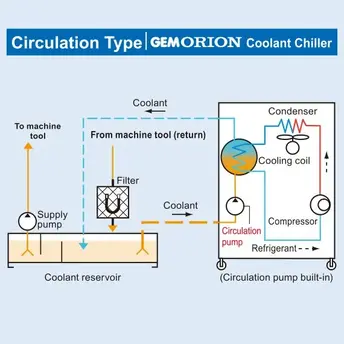

What the GCC Series does differently

Gem Orion's GCC Series is built specifically to hold coolant at a stable set temperature regardless of cutting load or ambient shop-floor conditions, so the machine sees the same thermal environment on part 1 and part 1,000.

In practice, that means:

  • ✅ Coolant temperature is actively regulated rather than left to drift with cutting duty cycle and shop ambient heat
  • ✅ Dimensional consistency improves across long unattended or multi-shift runs, since the thermal baseline doesn't shift through the day
  • ✅ Tool life improves because coolant retains its heat-removal and lubrication properties consistently, instead of degrading in performance as it warms
  • ✅ Scrap and rework linked to "unexplained" dimensional drift drops, because the biggest uncontrolled variable — coolant temperature — is now controlled

Why this matters more for 2026's growth push

As Indian precision shops scale up to meet automotive, aerospace, and EV component demand, more of them are running lines closer to capacity — longer shifts, higher utilisation, less idle time between jobs. That's exactly the operating pattern where coolant temperature drift becomes visible in the data: tighter tolerances demanded by aerospace and EV customers leave less room for the kind of variability an uncontrolled coolant loop introduces.

A shop that's already investing in high-accuracy CNC equipment to win this growth is leaving performance on the table if coolant temperature isn't held to the same standard as the machine itself.

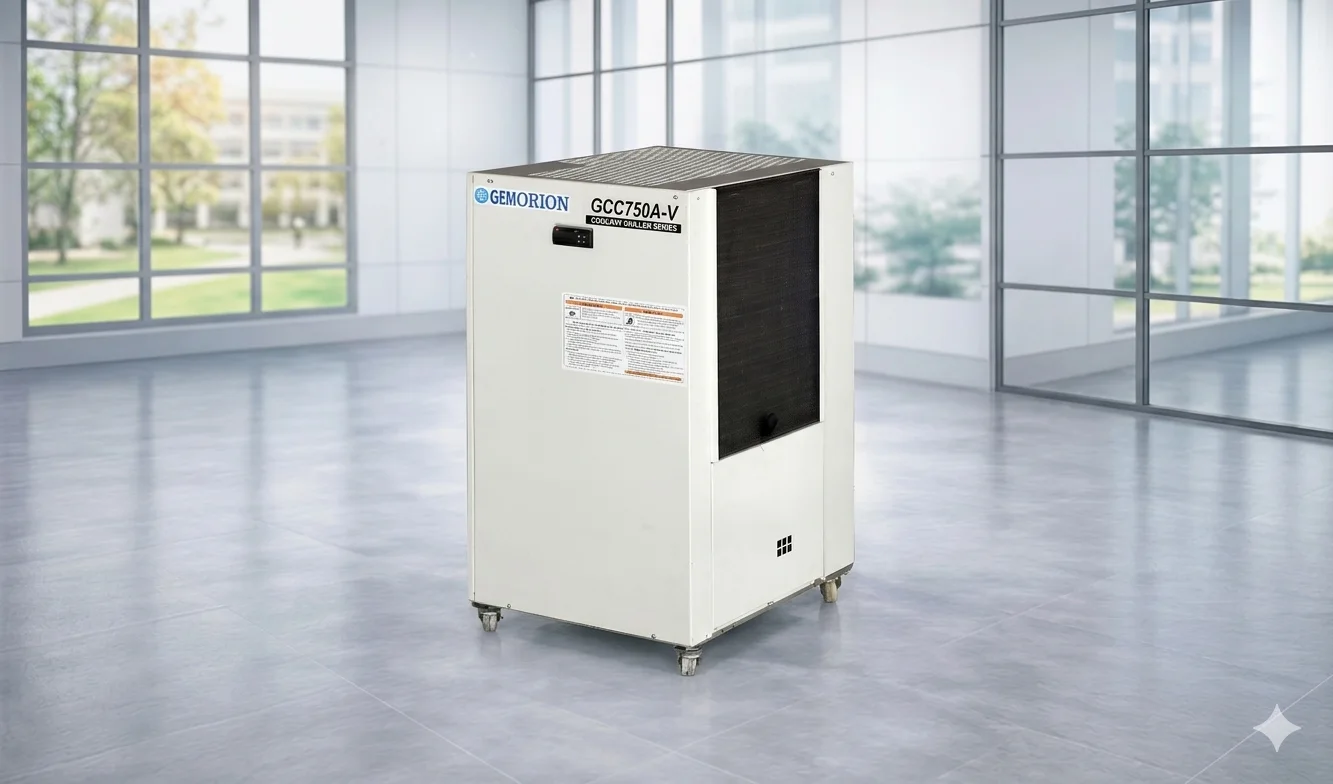
Gem Orion GCC Series coolant chiller construction

GCC Series at a glance

  • ✅ Function: Active coolant temperature regulation for CNC, grinding, and machine tool applications
  • ✅ Stability: Holds coolant at a consistent set-point independent of cutting load or ambient shop temperature
  • ✅ Impact on quality: Reduces thermal-drift-related dimensional variation across long and multi-shift runs
  • ✅ Tooling impact: Preserves coolant's heat-removal and lubrication performance, extending tool life
  • ✅ Build: Designed for continuous-duty operation on Indian shop floors, including high-ambient and humid conditions
  • ✅ Support: Backed by Gem Orion's Coimbatore-based engineering and service team
Gem Orion GCC Series coolant chiller unit

Worth checking on your shop floor

If your CNC line is producing parts that drift out of tolerance intermittently — with no change in programming, tooling, or operator — it's worth logging coolant temperature across a full shift before looking anywhere else. For many precision shops, that's where the answer turns out to be.

Talk to Gem Orion about the GCC Series →

Contact Us Today

Ready to improve your industrial cooling efficiency? Gem Orion Machinery provides reliable and customized chiller solutions tailored to your needs. Contact us today for expert guidance.

Sources: India CNC Machines Market Trends, Growth | Forecast 2034 — IMARC Group · India Machine Tool Market Size 2026-2030 — Technavio · Top Precision Manufacturing Companies in India (2026) — Zetwerk

logo
logo

Stay Updated with Us

Call Us
