Why this matters more in 2026
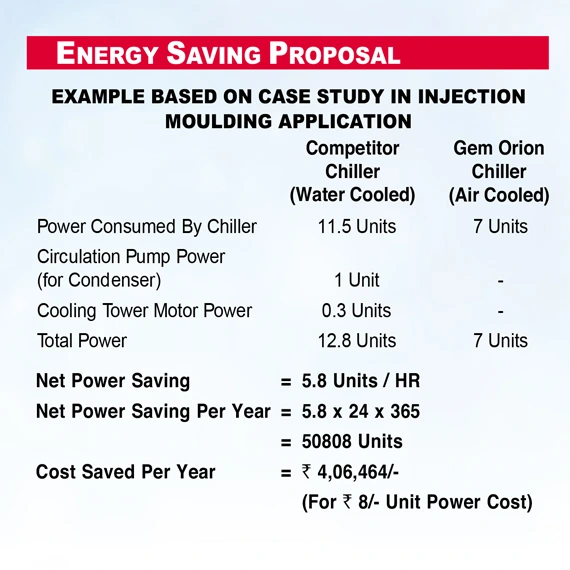
Two pressures are converging on Indian plastic manufacturers right now: rising electricity costs during peak summer months, and tightening expectations around energy efficiency and sustainability from customers and regulators alike. A chiller that quietly cuts a third of its energy draw addresses both at once — it's a direct cost saving on the utility bill, and it's a concrete efficiency number a plant can point to when asked about its environmental footprint.
For plants running multiple injection moulding lines around the clock, that saving compounds fast. A chiller upgrade that pays for itself through lower monthly power costs is a very different proposition than one bought purely for redundancy.
Where the GKE Series fits
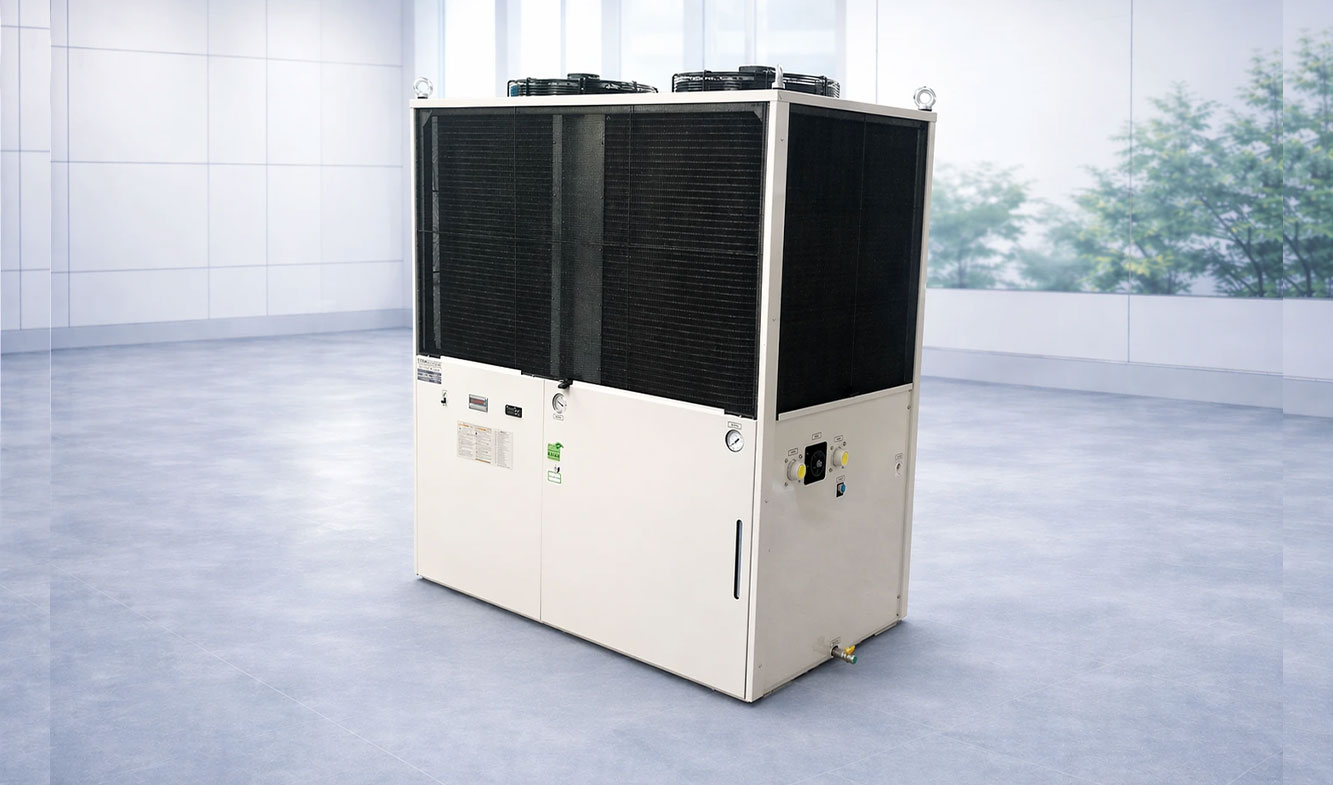
The GKE Series is built for exactly this workload — continuous, variable-demand cooling for injection moulding, blow moulding, and similar plastic processing lines where load changes throughout the production cycle. It's designed to hold process temperatures steady regardless of ambient conditions, which matters as much during Coimbatore's hot months as it does during the monsoon humidity swings.
A "Super El Niño" is now on the table for late 2026
The picture has sharpened since earlier in the year. As of August 2026, a Super El Niño is rapidly developing, with several forecast models pointing to it becoming the strongest El Niño on record — potentially exceeding the 1997-98 and 2023-24 events — as it peaks toward Q4 2026 and persists into mid-2027. The WMO has flagged that the combined effects of this Super El Niño and the Indian Ocean Dipole will be most pronounced between August and October 2026, with nearly every region globally running above-average temperatures through that window.
For India specifically, a monsoon rainfall deficit of around 20% has already been recorded, arriving ahead of El Niño's projected peak intensity — and forecasters expect drier-than-normal conditions to continue across the subcontinent as the event strengthens. That's a materially sharper outlook than the "weak monsoon, more heatwave days" forecasts circulating earlier in the year: this is now shaping up as one of the more extreme El Niño events on record, landing squarely across India's peak manufacturing months.
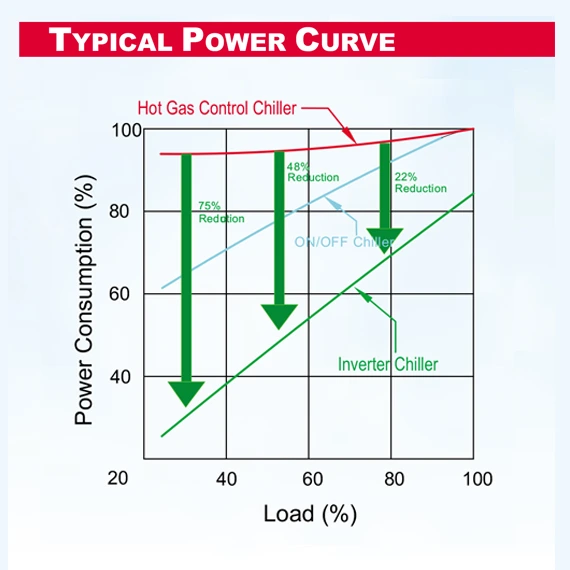
For a chiller, that combination matters more than any single extreme temperature reading. A larger monsoon deficit means fewer rain-cooled days breaking up the heat, so ambient temperatures stay elevated for longer stretches through the year. A fixed-speed chiller sized around "normal" seasonal swings ends up running near full load for far more days than it was designed for — which is exactly where the energy waste from constant on/off cycling compounds fastest.
This is where variable-speed cooling earns its keep in a record El Niño year specifically: instead of a chiller that's either maxed out or off, the GKE Series scales its compressor output to match whatever the extended hot season actually demands, day after day, without the plant absorbing a fixed worst-case power draw for months at a stretch.
GKE Series at a glance
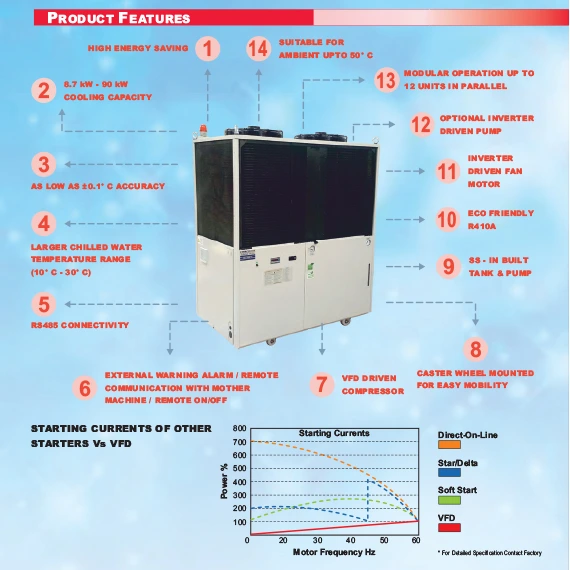
- ✅ Compressor: Inverter-driven, variable-speed — scales output to match real-time load instead of running fixed full/off cycles
- ✅ Temperature stability: Holds set-point within tight tolerance even as ambient conditions or process load shift through the day
- ✅ Energy performance: Up to ~30% lower power draw versus conventional fixed-speed chillers of comparable capacity
- ✅ Noise and vibration: Smoother compressor ramp-up reduces mechanical stress and running noise compared to hard on/off cycling
- ✅ Build: Engineered for continuous-duty operation in Indian factory conditions, including high ambient temperature and humidity swings
- ✅ Serviceability: Designed for straightforward local maintenance and support, backed by Gem Orion's Coimbatore-based service team
A simple way to look at the ROI
Consider a mid-sized plant running two injection moulding lines with a combined cooling load that keeps a fixed-speed chiller drawing close to its rated power most of the day. Switching to an inverter chiller sized for the same peak load, but running at variable speed, typically means the compressor spends most of its time well below full power — because actual heat rejection needs fluctuate through the moulding cycle, not stay constant.
Even a conservative 20–25% reduction in the chiller's monthly energy consumption adds up over a year, especially across multiple lines or shifts. For most plants, this is the fastest-payback upgrade on the shop floor — faster than most process machinery upgrades — because it's purely an operating cost reduction, not a capacity change.
Common questions manufacturers ask
Does an inverter chiller cost more upfront than a fixed-speed unit?
Typically yes, the initial cost is higher. The gap is usually recovered through lower electricity bills within the first one to two years of continuous operation, depending on load profile and local power tariffs.
Will it work with my existing injection moulding machines?
The GKE Series is designed to integrate with standard moulding, blow moulding, and similar plastic processing setups without requiring changes to the existing machine side. Sizing should be matched to your actual heat load rather than the machine's nameplate rating.
Does it need special maintenance compared to a standard chiller?
No specialised maintenance regime is required. Routine checks — refrigerant levels, filter condition, condenser cleanliness — apply the same way, with the added benefit of reduced compressor wear from smoother operation.
Is it suitable for humid, coastal, or high-ambient locations?
Yes. The unit is built to hold process temperature steady even as ambient temperature and humidity vary, which is relevant across most Indian manufacturing hubs, not just hot, dry regions.
Worth checking before your next power bill cycle
If your plant is still running a fixed-speed chiller on a moulding line with variable output, it's worth comparing your current power draw against what an inverter-based system would use for the same load. For most plastic manufacturers, that comparison alone makes the case.
Talk to Gem Orion about the GKE Series →
Contact Us Today
Ready to improve your industrial cooling efficiency? Gem Orion Machinery provides reliable and customized chiller solutions tailored to your needs. Contact us today for expert guidance.
Sources: 2025 Trends Driving Demand for Advanced Plastic Injection Moulding Machines in India — STM Plastic · India Plastic Injection Molding Machine Market 2024-2030 — Mobility Foresights · NOAA Says Strengthening El Niño Could Become Strongest On Record By Late 2026 — HNGN · Combined Impacts of Super El Niño and Indian Ocean Dipole to be Recorded Between August and October — Down To Earth · Strong El Niño Expected to Intensify — World Meteorological Organization · What the "Strongest El Niño on Record" Actually Means (For Humans) — CNN