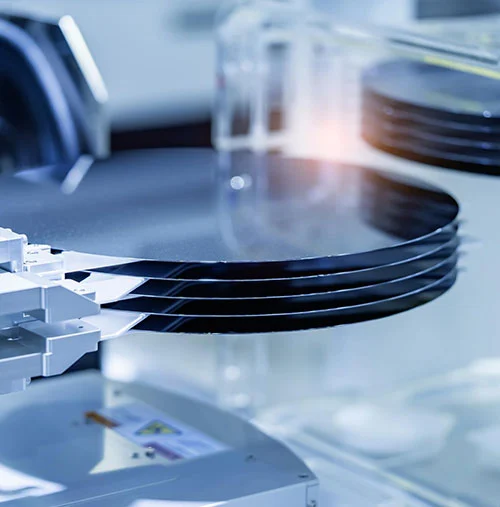

India is building its semiconductor ecosystem at speed. Fabrication plants, OSAT (Outsourced Semiconductor Assembly and Test) units, display and solar-cell lines, and component makers are all expanding under the India Semiconductor Mission. Every one of these facilities shares one invisible requirement: heat must be removed from the process — precisely, continuously and without interruption.
In semiconductor manufacturing, temperature is not a utility parameter. It is a quality parameter. A drift of even one degree at the wrong stage can shift a pattern, change an etch rate or affect a deposited film — and that shows up directly as lost yield. That is why the process chiller is one of the most critical pieces of equipment on the fab floor.
Why Temperature Control Is Critical in Semiconductor Processes
Modern chip manufacturing works at nanometre-level features. At this scale, materials expand and contract with very small temperature changes, and chemical reaction rates respond quickly to heat. Stable cooling keeps every wafer seeing the same conditions, batch after batch.
- ✅ Dimensional stability — wafer chucks, stages and optics must hold a constant temperature so patterns align correctly layer to layer.
- ✅ Process repeatability — etch, deposition and polishing rates depend on temperature; stable cooling gives consistent results across lots.
- ✅ Equipment protection — RF generators, plasma sources, vacuum pumps and power supplies run hot and fail early if cooling fluctuates.
- ✅ Uptime — an unplanned chiller trip can stop a tool mid-process and scrap the wafers inside it.